


CIGSolar™ Technology
As a technology development company, we believe that our success comes from empowering our partners with breakthrough technology that incorporates the best systems and designs to address product market needs, rapid time to market to stay ahead of the competition, and pricing to make solar affordable for our partners and their clients.
The XsunX CIGSolar™ Production Line enables our partners to upgrade existing infrastructure or establish new large-scale manufacturing capacity to produce low cost high performance 125mm square CIGS solar cells for use in a multitude of applications.
How: We are leveraging and adapting cross cutting technologies from our partners in the mature hard disk technology space and high-speed flex circuit printing technology sector to create a new breed of CIGS manufacturing technology that can be rapidly deployed to produce CIGSolar cells. The potential impact of this technology, and its compelling economic advantage, enables us to compete in regard to cost and efficiency by offering commercially viable replacements to existing incumbent poly-crystalline silicon technology, lowering the overall cost of PV energy.
Eliminating Variables: This rapid single cell processing approach provides the platform needed to bridge the gap between laboratory and production module efficiency by reducing composition variation and defects, while simultaneously achieving tighter process controls.
Innovations: The key areas of innovation are based upon the integration and process control of these enabling cross-cutting technologies:
- Development of a patent-pending CIGS small area thermal evaporation system, including the unique CIGS High Temperature Effusion (HTE) sources;
- Adaptation of printed circuit board curtain coating for the aqueous CdS buffer layer;
- Adaptation of high speed flex circuit screen printing for a combination of dielectric barriers and conductive silver busses and fingers for current collection grids, and
- Optimizing front and back contact sputtering processes utilizing mature Hard Disk (HD) technology.
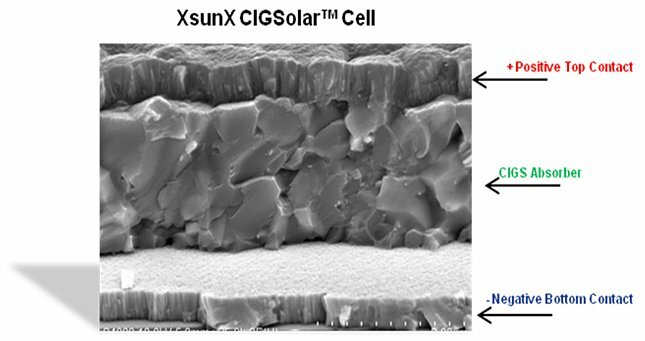
NREL: Using small substrates, the US National Renewable Energy Laboratories routinely achieves high efficiencies for CIGS with 19.9% peaks. Following their example, XsunX has already achieved 15% plus efficiencies and continues to improve processes and conversion efficiencies at the cell level.
For more information on how your organization can benefit from our unique and proprietary CIGSolar lines, please email and provide us with some information on your organization and goals.